
She Doesn't Do It All: How Ambitious Women Avoid Burnout Without the Guilt
Ambitious? Stop the superwoman myth and avoid burnout. Get practical tips on setting boundaries, self-care, and finding sustainable success without the guilt.


It was 11 PM on a Tuesday, and I was sitting at my laptop answering "just a few more emails" while simultaneously mentally running through tomorrow's meetings, worrying about whether I'd prepped enough for my Zoom call, remembering I needed to respond to my friend's text from three days ago, and feeling guilty about the fact that I couldn't remember the last time I'd worked out or had a real conversation with anyone that wasn't about logistics.
Sound familiar?
Here's what nobody told us when we were busy being ambitious, driven, and determined to succeed: the "superwoman" thing is a myth. A damaging, exhausting, impossible myth. You cannot do it all, be it all, and have it all without eventually hitting the wall so hard that you see stars.
And yet, we keep trying. We wear our exhaustion like a badge of honor. We brag about how little we slept. We apologize for taking breaks. We feel guilty for having needs.
Well, I'm here to tell you something important: you can be wildly ambitious AND take care of yourself. These things are not mutually exclusive. In fact, sustainable success requires self-care. Not as an indulgence. Not as something you do if you have time left over. But as a fundamental necessity.
So let's talk about how to avoid burnout without the guilt, shall we? Because you deserve to thrive, not just survive.

The Burnout Epidemic Among Women
Let's start with some honesty: burnout among women, both career-focused women and homemakers, is not just common; it's practically an epidemic.
And before you think, "Well, everyone's stressed, it's not just women," let me stop you there. Yes, everyone experiences stress. But women face unique pressures that make us particularly vulnerable to burnout.
Why women struggle with burnout
We're often juggling multiple roles and expectations. Professional success. Domestic responsibilities. Emotional labor. Looking put-together. Being available. Supporting everyone else. The list is endless.
Even women without children or partners often find themselves shouldering disproportionate emotional and logistical labor at work and in their social circles. We're the ones who remember birthdays, organize team events, notice when someone's struggling, and smooth over conflicts.
The cultural expectation to "do it all" and "have it all"
We grew up hearing we could have it all. Career! Family! Perfect home! Social life! Hobbies! Fitness! And we believed it. We internalized the message that if we just worked hard enough, planned well enough, and optimized every moment, we could achieve this impossible standard.
Spoiler alert: it's a setup for failure and exhaustion.
The reality of burnout
Burnout isn't just being tired. It's a state of physical, emotional, and mental exhaustion caused by prolonged stress. It's when you feel detached from your work, cynical about things you used to care about, and ineffective despite your efforts.
Some women describe it as running on empty. Others say it feels like they're underwater, everything muffled and slow. Some just feel... nothing. Numb. Going through the motions.
The cost of ignoring burnout
Your health suffers. Chronic stress wreaks havoc on your body. We're talking weakened immune system, sleep problems, digestive issues, headaches, and increased risk of serious conditions.
Your relationships suffer. When you're burned out, you have nothing left to give to the people you love. You're irritable, distracted, and emotionally unavailable.
Your career suffers. Ironically, the thing you're sacrificing everything for starts to suffer too. Burned-out people make more mistakes, struggle with creativity and problem-solving, and eventually hit a wall where they simply can't push through anymore.
Your joy suffers. This might be the saddest part. Things you used to love feel like obligations. Life becomes a series of tasks to complete rather than moments to experience.
Recognizing the signs:
- Constant exhaustion that sleep doesn't fix.
- Difficulty concentrating.
- Increased cynicism or negativity.
- Physical symptoms like headaches or stomach issues.
- Feeling emotionally flat or detached.
- Dreading things you used to enjoy.
- Relying on coping mechanisms (wine, shopping, scrolling) more than usual.
If you're reading this list and thinking "yep, yep, yep," please keep reading. It doesn't have to be this way.
Why Self-Care Isn't Selfish (But We Still Feel Guilty)
Okay, can we talk about the guilt? The soul-crushing, ever-present guilt that shows up the moment we even think about prioritizing ourselves?
You know what I'm talking about. That voice that says, "Other people are working harder than you." Or "You should be able to handle this." Or "Taking time for yourself is indulgent when there's so much to do."
That voice is a liar.

Unpacking the guilt
Most of us were raised with messages about being nice, helpful, and accommodating. We learned that good women put others first. That our value comes from what we provide to other people. That our needs come last, if at all.
This conditioning runs DEEP. Even when we intellectually know better, that guilt creeps in.
The conditioning about putting everyone else first
Think about the language we use. When a man prioritizes his career or takes time for his hobbies, he's "driven" or "dedicated." When a woman does the same thing, she's "selfish" or "not putting her family first."
When a man says no to additional work, he's "setting boundaries." When a woman does it, she's "not a team player."
We've internalized these double standards so thoroughly that we police ourselves.
Reframing self-care as a necessity
Here's the truth: self-care is not selfish. It's self-preservation. It's the maintenance required to keep functioning.
You wouldn't feel guilty about putting gas in your car or charging your phone, right? Those things NEED fuel to work. So do you.
Self-care isn't about luxury spa days (though those are nice). It's about meeting your basic needs. Sleep. Nutrition. Movement. Mental health. Connection. Rest.
How taking care of yourself makes you better:
- When you're rested, you think more clearly.
- When your needs are met, you have more to give.
- When you model healthy boundaries, you teach others to respect them.
- When you prioritize your well-being, you show up as a better partner, friend, colleague, and leader.
You cannot pour from an empty cup. You've heard this before, and it's true.
The airplane oxygen mask analogy
In an emergency, you put your own oxygen mask on first before helping others. Not because you're selfish, but because if you pass out, you can't help anyone.
This applies to life, too. Taking care of yourself first isn't selfish. It's strategic. It's necessary. It's the only way you can sustainably show up for everything and everyone else you care about.
Identifying Your Personal Burnout Triggers
Not everyone burns out the same way or for the same reasons. Understanding YOUR specific triggers is crucial for preventing burnout.
Common triggers for ambitious women:
- Overcommitting: Saying yes to everything because you don't want to disappoint anyone or miss opportunities.
- Perfectionism: Believing that everything you do must be flawless, which is both exhausting and impossible.
- People-pleasing: Prioritizing everyone else's needs, opinions, and comfort over your own.
- Lack of boundaries: Being available 24/7, not protecting your time or energy.
- Imposter syndrome: Constantly feeling like you need to prove yourself, leading to overwork.
- All-or-nothing thinking: Believing that if you can't do something perfectly or completely, you shouldn't do it at all.
How to recognize YOUR patterns:
- Pay attention to what drains you versus what energizes you.
- Notice when you feel resentful (that's often a sign your boundaries are being violated).
- Track when you feel most overwhelmed.
- What situations consistently leave you exhausted?
The difference between healthy hustle and harmful overwork:
- Healthy hustle: You're working hard toward goals that matter to you, but you're also resting, maintaining relationships, and generally feeling engaged and energized (even when tired).
- Harmful overwork: You're constantly exhausted, work has taken over your entire life, you can't remember the last time you felt genuine joy, and you're running on fumes and obligation.
Warning signs your body is sending
Your body is smart. It sends signals when something is wrong. The problem is, we've learned to ignore them.
Are you getting sick more often? Having trouble sleeping? Experiencing unexplained aches and pains? Notice changes in appetite? Feeling constantly on edge or anxious?
These aren't things to push through. They're messages.
Reflection questions to identify YOUR triggers:
- When do you feel most overwhelmed?
- What requests or situations make you want to say no, but you say yes anyway?
- Who or what consistently drains your energy?
- What obligations do you resent?
- If you could remove one thing from your life, what would it be?
- What are you tolerating that you shouldn't be?
Grab a journal and actually answer these. The patterns will become clear.
Setting Boundaries Without Sabotaging Your Success
Boundaries. The word every woman knows she needs but struggles to actually implement.
Why? Because we're terrified that boundaries will make us seem difficult, uncommitted, or not serious about our careers.

Why boundaries feel scary
We fear we'll miss opportunities, and worry people will think we're not dedicated. We're concerned we'll be passed over for promotions or lose clients. We don't want to seem high-maintenance or demanding.
These fears feel very real. Sometimes they're even based on actual experiences where we faced consequences for setting boundaries.
The fear that saying "no" will hurt your career
Honestly, in some toxic work environments, setting boundaries DOES have consequences. But here's what I've learned: if your success requires you to be constantly available, perpetually exhausted, and without personal boundaries, that's not sustainable success. That's a recipe for burnout and resentment.
The right opportunities, clients, and employers will respect your boundaries. The wrong ones will push back. And that pushback actually gives you valuable information about whether this is somewhere you want to be long-term.
How to set boundaries at work:
- Establish clear work hours and stick to them (with reasonable flexibility for truly urgent situations).
- Turn off notifications outside work hours.
- Learn to say, "Let me check my calendar and get back to you" instead of immediately saying yes to every request.
- Delegate tasks that don't require your specific expertise.
- Block time for focused work where you're unavailable for meetings or interruptions.
- Use email signatures or out-of-office messages that set expectations about response times.
How to set boundaries in personal life:
- It's okay to say no to social invitations when you need rest.
- You don't have to be immediately available to everyone all the time.
- You can turn off your phone sometimes.
- You're allowed to have time that's just for you, with no productivity attached.
- You can stop doing things you don't actually want to do just because you "always have."
Scripts for communicating boundaries:
- "I'm not available for calls after 7 PM, but I'd love to schedule something during the day."
- "I can't take on additional projects right now, but I can revisit in [timeframe]."
- "That doesn't work for my schedule. Here's when I'm available."
- "I need to focus on existing commitments before taking on anything new."
- "I appreciate you thinking of me, but I'm going to pass on this opportunity."
Notice: no long explanations, no over-apologizing, just clear and kind communication.
The truth about boundaries
People who respect you will respect your boundaries. People who push back on reasonable boundaries are usually the ones who benefited from you not having any.
And here's the surprising part: boundaries often INCREASE respect. When you value your time and energy, others learn to value it too. When you're selective about what you commit to, the commitments you do make carry more weight.
Redefining Productivity and Success
We need to have a serious conversation about productivity culture and what "success" actually means.
Because somewhere along the way, we bought into some really toxic ideas about what it means to be productive and successful.

Challenging the "hustle culture" mentality
Hustle culture tells us that success requires constant work, that rest is lazy, that if you're not exhausted, you're not trying hard enough.
It's glorified suffering. And it's making us miserable.
Some of the most productive people in the world are strategic about their rest. They understand that sustainable high performance requires recovery.
Rest as a productive activity
This might blow your mind, but rest IS productive. Your brain processes information during downtime. Your body repairs itself during sleep. Your creativity flourishes when you're not forcing it.
Rest isn't the absence of productivity. It's a different kind of productivity. It's investment in your future capacity.
Quality over quantity
Working 60 hours a week doesn't make you more successful than someone working 30 focused, strategic hours. Being busy doesn't mean being effective.
What if instead of measuring success by how much you do, you measured it by the impact of what you do? By whether you're moving toward goals that actually matter to you? By whether you're happy and healthy while achieving things?
Measuring success beyond output
Sure, achievements matter. But so does:
- Your health and well-being
- How you feel about your life
- The quality of your relationships
- Your sense of purpose and meaning
- The joy you experience
- Your ability to grow and learn
- Your ability to be present
Success is multidimensional. When we reduce it to just professional achievement or financial metrics, we lose sight of everything else that makes life worth living.
What sustainable productivity looks like:
- Focused work sessions with breaks in between.
- Prioritizing the most important tasks rather than trying to do everything.
- Having rhythms of intensity followed by periods of recovery.
- Saying no to good opportunities so you can fully commit to great ones.
- Protecting your energy as carefully as you protect your time.
Permission to have different seasons
Some seasons of life require more intensity. That's okay. But they should be seasons, not your permanent state.
You're allowed to have periods where you go hard, and periods where you pull back. Where you sprint, and where you rest. Where work takes center stage, and where other parts of life get priority.
Your worth isn't determined by maintaining peak productivity at all times.
Practical Self-Care That Actually Works
Okay, let's get practical. Because self-care has become so commodified and Instagram-ified that we've lost sight of what it actually means.
Self-care is not just bubble baths and face masks. Though if those things bring you joy, great! But real self-care is often less glamorous and more essential.

Moving beyond bubble baths
Real self-care includes things like:
- going to the doctor when something's wrong,
- having hard conversations, setting boundaries,
- leaving situations that harm you,
- asking for help, saying no,
- getting enough sleep,
- feeding yourself nourishing food,
- moving your body in ways that feel good.
It's maintenance, boundaries, and meeting your actual needs. Not just feel-good indulgences.
Daily non-negotiables vs. occasional treats:
- Daily non-negotiables are the things you do consistently to maintain baseline wellbeing: adequate sleep, basic nutrition, some form of movement, and a few minutes of quiet or transition time.
- Occasional treats are the extra things: massages, long baths, weekend getaways, special experiences.
You need both, but the daily stuff is what prevents burnout. The treats are just bonuses.
Self-care for different aspects of life
If you think about it, you can apply self-care to many aspects of your life, and you would be wise to do so. Look at these types of self-care to gauge how well you are taking care of yourself or if there is room for improvement:
Physical self-care involves treating your body with care and consistency. This means prioritizing 7–9 hours of sleep, staying hydrated, and eating regular meals with foods that make you feel good. Instead of viewing exercise as punishment, focus on moving your body in ways you genuinely enjoy. It also means taking care of your medical needs by going to appointments, taking medication as prescribed, and allowing yourself to rest whenever you’re sick.
Mental self-care is largely about managing your headspace and protecting your peace, which often requires limiting how much news and social media you consume. It involves setting clear boundaries around your time and availability, as well as making sure to take actual breaks throughout the workday. To truly recharge, try carving out tech-free time to engage in activities that require your full focus and presence, or simply learn something new for the pure enjoyment of it.
Emotional self-care is about giving yourself permission to actually feel your feelings instead of constantly pushing them down or pretending difficult experiences didn't happen. It involves processing those emotions honestly, which includes crying when you need to. You can support this emotional health by talking to a therapist, using journaling as a tool for reflection, or finding specific outlets for creative expression.
Social self-care is about cultivating connections that uplift you, which starts with spending time with people who energize you. It requires setting limits by saying no to draining relationships or obligations. Instead of keeping interactions superficial, focus on having meaningful conversations and being honest about your struggles rather than pretending everything is fine. Crucially, it also means leaning on your community by asking for support whenever you need it.
Professional self-care involves setting healthy boundaries to prevent burnout. This starts with everyday habits like taking breaks, delegating tasks, and resisting the urge to check email constantly outside of work hours. It means having the courage to ask for help or resources when you need them. On a broader scale, it requires actually taking your vacation days to recharge and intentionally investing in your own professional development and growth.
Making self-care realistic for busy schedules
If you are short on time, there are plenty of effective 5-minute options available. You might try deep breathing exercises, a quick walk around the block, or a simple stretching session. Sometimes it is enough to just step outside for fresh air or sit in silence while you drink your coffee or tea. You could even use that brief window to call a friend or energize yourself by dancing to one song.
With 30 minutes available, you have enough time to engage more deeply with self-care. You could fit in a full workout, a yoga session, or a longer walk to clear your head. If you need to decompress, try taking a bath or shower without rushing, or curl up and read for pleasure. This is also a great window for spending time on a creative hobby, getting ahead on meal prep, or connecting with someone through a meaningful conversation.
When you have the luxury of a full day, consider taking a day trip to explore somewhere new or immersing yourself in nature. You might opt for a dedicated self-care day where you sleep in, enjoy a slow morning, and fill your time with activities you genuinely enjoy. A spa day is always a treat, but you should also feel free to do absolutely nothing—seriously, having a day with zero agenda is incredibly underrated.
The point is, self-care comes in all sizes. You don't need hours and hours. Start with what you can manage.
Asking for Help and Delegating (Without Feeling Like a Failure)
We've internalized this message that we should be able to handle everything ourselves. That needing help means we're weak, incapable, or failing.
That's garbage.

Why asking for help feels so hard
Asking for help often feels incredibly hard because we worry it makes us look incompetent or fear that we might be judged. Many of us have been taught that being self-sufficient is a virtue, which makes us hesitant to reach out because we don't want to inconvenience anyone. Furthermore, if you are a perfectionist, you might hold back simply because you believe no one else will do the job as well as you would.
Sometimes we've asked for help before and been disappointed or let down, so we've stopped asking.
The "I can do it better myself" trap
Yes, maybe you CAN do it better yourself. But should you? Is this the best use of your time and energy? Is being the only one who can do things really serving you, or is it just feeding your need for control?
And here's a secret: sometimes other people can do it just as well as you, or even better. They just do it differently.
What can and should be delegated:
- At work: Administrative tasks, routine processes, things that don't require your specific expertise, tasks that develop others' skills, anything that's not mission-critical or strategic.
- At home: Housework (hire help if you can afford it), meal planning (grocery delivery, meal kits, taking turns cooking), errands (delivery services, grocery pickup), childcare (partners, family, babysitters), mental load items (share calendar management, delegate specific responsibilities).
Here is the general rule of thumb when trying to figure out if you should delegate something or not: if someone else can do it 80% as well as you can, delegate it.
Outsourcing strategically
Not everyone can afford to outsource everything, but most of us can outsource SOMETHING. Maybe it's a housecleaner once a month. Grocery delivery. A virtual assistant for a few hours a week. Someone to handle your bookkeeping.
Calculate your hourly rate (or what your time is worth to you). If you can pay someone less than that to do something you hate doing, it's often worth it to free up your time and energy for things that matter more.
Letting go of perfection
Things don't have to be done your exact way to be done well enough. Your partner loading the dishwasher differently than you do still gets the dishes clean. Your assistant organizing files in a different system is okay. If it works, it works.
Perfectionism about how things are done keeps you stuck doing everything yourself.
Creating Systems and Routines That Support You
Want to know a secret? Successful people aren't more disciplined than you. They just have better systems.
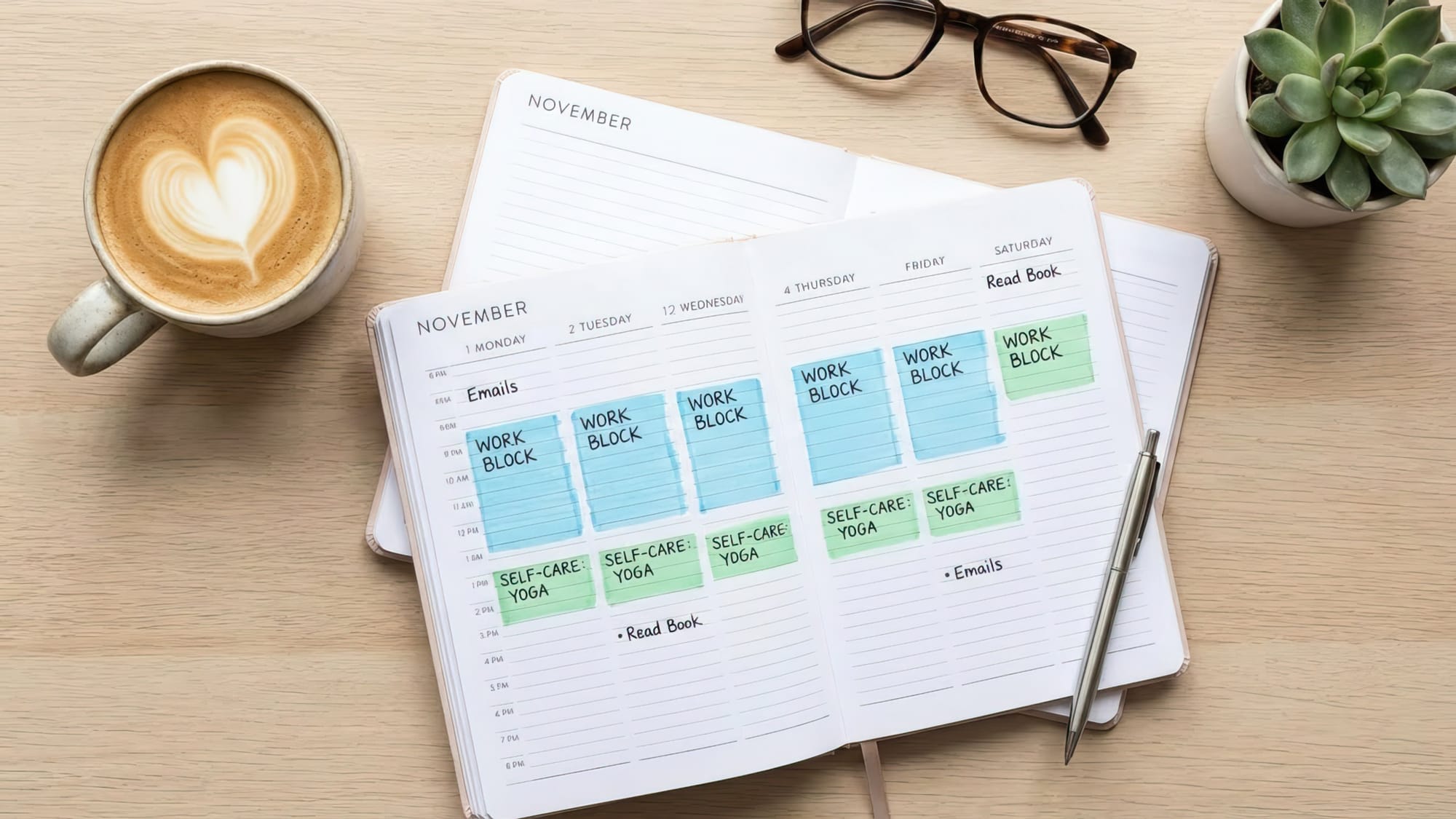
Systems and routines reduce decision fatigue, create consistency, and free up mental energy for things that actually matter.
The power of automation and systematization
Anything you do repeatedly should be systematized. Create templates, checklists, and standard processes. Automate payments, reminders, and routine communications.
The less you have to think about routine stuff, the more brain space you have for important decisions.
Time-blocking and protecting your energy
Block time on your calendar for focused work, not just meetings. Treat these blocks as appointments you can't cancel.
Protect your peak energy hours for your most important work. If you're sharpest in the morning, don't waste that time on email.
Schedule breaks. Actually put them in your calendar if you have to.
Batch working and task grouping
Group similar tasks together. Answer all emails in designated time blocks. Make all your phone calls at once. Do all your content creation in one session.
Context-switching is exhausting. Batching reduces it.
Technology tools that reduce mental load
Start by utilizing calendar apps that sync across your devices and task management systems; just make sure to find one that works for your specific brain type. You can also simplify daily life with password managers, meal planning apps, and grocery delivery or pickup services. For running a home, shared calendars and to-do lists are incredibly helpful.
The goal is to use technology to reduce the sheer number of things you have to rely on your memory to keep track of.
Weekly planning that includes rest
Spend 30 minutes each week reviewing and planning. But here's the key: schedule your rest and self-care FIRST. They're not things you do if you have time left over. They're appointments you keep.
Plan your work around your life, not your life around your work.
Managing the Mental Load
Let's talk about something that's absolutely exhausting but often invisible: the mental load.
The mental load is essentially the invisible burden of remembering and planning everything. It goes beyond just executing tasks; it involves anticipating future needs, keeping track of endless details, and coordinating complex schedules. It is that constant background process of noticing what needs to be done without being told and following up to ensure those things actually happen.
It's not just doing the tasks. It's being the one who has to remember the tasks exist, figure out how to do them, and delegate them if necessary.

How women carry disproportionate mental load
Studies show that even in relationships where household tasks are divided fairly evenly, women still carry significantly more of the mental load. We're the ones who remember that the kids need forms signed, notice when we're running low on toilet paper, plan meals for the week, remember birthdays, and schedule appointments.
It's exhausting. And it's largely invisible, so people don't realize how draining it is.
Strategies for reducing decision fatigue:
- Make fewer decisions. Seriously. Reduce your options where it doesn't matter.
- Create uniforms or capsule wardrobes so you're not deciding what to wear every day. Meal plan so you're not deciding what to eat every night. Have standard routines, so you're not deciding what to do each morning.
- Automate decisions wherever possible.
- Create systems so everything isn’t in your head (write things down, use external reminders, and checklists).
Sharing the mental load
This requires explicit conversation, especially in partnerships. "I need you to own this completely" means they remember it, plan it, do it, and follow up on it. Not "ask me what needs to be done."
Create shared systems. Shared calendars. Shared task lists. Divided responsibilities where each person OWNS certain areas.
And here's the hard part: you might have to let go of control over how things are done.
Although there is power in saying, "We agreed you would handle that, it’s no longer my responsibility."
When to Pivot, Pause, or Pull Back
Sometimes, despite your best efforts at boundaries and self-care, you realize you need to make bigger changes. And that's okay. That's actually healthy.
Having the courage to pivot doesn't mean you failed; it simply means you are being honest about what is working and what isn't. You might realize that your business model isn't sustainable, or perhaps your career path is no longer actually aligned with your values. It could even be that your definition of success has evolved. Ultimately, it takes real courage to admit when something needs to fundamentally change.
Taking a sabbatical or extended break isn't about giving up; think of it as a pause or strategic recovery. Sometimes you need more than just a vacation; you need actual time away to rest, reflect, and recalibrate.
If you can afford it (and many people can't, which is a whole systemic issue), taking a staycation can prevent complete burnout and give you perspective.
Sometimes the answer isn't to stop entirely, but rather to scale back temporarily. This might mean reducing the time you spend on tasks that drain you, lowering your client load, or stepping back from leadership responsibilities for a while. You might even consider working a less demanding job while you recover. There is absolutely no shame in scaling back; in fact, it is often the smartest move you can make.
Redefining What “Ambitious” means for YOU
Who decided that ambition has to mean constantly expanding, taking on more, and never being satisfied? You can be ambitious about completely different things, like your health, your relationships, or simply finding presence and joy. It is okay to be ambitious about building a life that is sustainable for you, rather than one that looks impressive but feels miserable.
In the same way, success doesn't always mean having "more" revenue, visibility, or responsibility. Sometimes success actually means having less; less stress, less overwhelm, and fewer obligations you don't care about. Real success is about achieving the life you actually want, not the curated version Instagram tells you to chase.
You Don't Have to Do It All
So here we are. We've covered everything from recognizing burnout to setting boundaries to completely redefining success.
Let's bring it all together: You. Don't. Have. To. Do. It. All.

Here's what I want you to remember:
- You can be ambitious AND well-rested.
- You can be successful AND have boundaries.
- You can be driven AND prioritize self-care.
- These things are not mutually exclusive. In fact, they're synergistic.
The most sustainable success comes from honoring your humanity, not denying it.
This is a practice, not perfection:
- You might slip back into old patterns sometimes.
- You might overcommit in the future.
- You might ignore your needs.
- You might feel guilty about boundaries.
That's okay. This is lifelong work. What matters is noticing when it happens and gently redirecting yourself back to healthier patterns.
Just remember:
- You're allowed to be ambitious without sacrificing yourself at the altar of success.
- You're allowed to have boundaries, needs, and limits.
- You're allowed to rest without earning it.
- You're allowed to ask for help.
- You're allowed to change your mind about what you want.
- You're allowed to prioritize your well-being.
Not because you've earned it. Not because you've done enough. But because you're a human being who deserves to be healthy, happy, and whole.
My Challenge to You:
This week, choose ONE thing from this article to implement. Just one.
Maybe it's setting a single boundary. Maybe it's delegating one task. Maybe it's blocking 30 minutes for yourself every day. Maybe it's going to bed 30 minutes earlier. Maybe it's asking for help with one specific thing.
Start small. Build momentum. You don't have to overhaul your entire life this week.
And share your experience! What did you choose to implement? How did it go? What did you learn? Drop a comment or share your story with #SheDoesntDoItAll so we can all learn from each other and support one another.